BBE vs WISO at WU Vienna: Entrance Exam Comparison Guide
Choosing between WU Vienna’s BBE and WISO programmes starts with the entrance exams behind them. This independent guide compares language, subjects, places, selectivity, and preparation, so you can decide which path fits you.
Quick answer: BBE vs WISO
BBE is WU Vienna’s English-taught Bachelor’s Program in Business and Economics. WISO is the German-taught Bachelor’s Program in Business, Economics and Social Sciences. Both selection procedures usually include a written, in-person multiple-choice entrance exam when registrations exceed places. The practical differences that matter most for applicants are language of study, the language section on the exam, how many seats exist, and when you can start.
BBE places
240
WISO places
2703
BBE exam language
English
WISO exam language
German
Side-by-side comparison
Use this table as a decision snapshot. For BBE exam format details, see the BBE Entrance Exam Overview linked below.
| Aspect | BBE | WISO |
|---|---|---|
| Programme language | English-taught | German-taught |
| Full programme name | Business and Economics (BBE) | Business, Economics and Social Sciences (WISO) |
| Exam language focus | English (grammar, vocabulary, reading) | German language comprehension |
| Shared exam pillars | Mathematics + economics/business basics | Mathematics + economics/business basics |
| Places (recent cycle) | 240 | 2703 |
| Selectivity signal | Very high (often ~16 applicants per place) | High, but more places available |
| Programme start | Winter semester only | Winter or summer semester possible after a successful procedure |
| Typical cohort feel | Smaller, international, English campus life | Larger programme with broader specialisation paths later |
Places and selectivity
Place counts are the clearest structural difference. WISO offers many more seats; BBE remains one of WU’s most competitive bachelor intakes. In a recent WU announcement, roughly 3,900 people were eligible for the BBE exam against 240 places, while about 6,370 were eligible for WISO against 2,703 places.
How many seats exist?
Each block below is drawn to scale. WISO has about 11× as many places as BBE.
How many people compete for one seat?
Read it as: “for every 1 place, about this many eligible applicants.”
BBE
~16
eligible applicants per place
1 seat · each dot ≈ one competitor
WISO
~2.4
eligible applicants per place
1 seat · each dot ≈ one competitor
Plain reading: BBE is the scarcer seat. WISO draws more total applicants, but spreads them across far more places: so each WISO seat is less contested than each BBE seat.
Charts use approximate recent-cycle figures for illustration. Competition ratios move with each year’s registrations.
What each entrance exam tests
Both exams are multiple-choice and typically cover mathematics plus basic economics and business knowledge. The language pillar is where they diverge: BBE tests English; WISO tests German comprehension.
BBE written exam
- Economics & business fundamentals
- English grammar, vocabulary, and reading
- Mathematics at Austrian school-leaving depth
- Most recent BBE structure: 34 questions in 2 hours (10 Economics, 11 English, 13 Math)
WISO written exam
- Economics & business fundamentals
- German language comprehension
- Mathematics
- Most recent WiSo structure: 32 questions in 2 hours (10 Economics, 9 German, 13 Math)
BBE approximate score weighting
From the most recent cycle’s section point totals, not the share of question counts.
- Economics: 37.5%
- English: 19%
- Mathematics: 43%
Where the exams diverge
Shared pillars sit in the middle. Language is the fork that decides most of your prep plan.
Train English reading, grammar, and vocabulary under BBE statement style.
Train German comprehension for the WISO language section.
Question style: what actually feels different
Applicants often ask whether the “questions themselves” are the same. The short answer: the subject pillars overlap, but the way BBE tasks are written and scored is a study problem of its own.
How BBE questions usually work
- One stem (scenario, claim, passage, or calculation) with several statements you judge independently.
- Partial credit: correct ticks and wrong ticks interact, with a floor at zero for that question.
- Approximate score weighting from the most recent cycle: Economics 37.5%, English 19%, Mathematics 43%.
- Math stems often mean multiple calculations under one question, so time management matters as much as knowing the method.
How WISO questions usually differ
- Same broad pillars, economics/business basics, language, mathematics, but the language tasks are in German, not English.
- Multiple-choice only, held in person when the selection procedure runs; confirm current item counts and timing on official WU materials.
- German comprehension is not a small add-on: weak reading speed or vocabulary can cost points even if your math is strong.
- Because there are far more places, the ranking pool is larger and less scarce, but it is still a competitive WU intake.
If you are aiming at BBE specifically, dig into the Mathematics and Economics & English guides next.
Shared admission process building blocks
Despite different programmes, the administrative spine often looks similar: register in the published window, complete the Online Self-Assessment (OSA) if required, then sit the written exam if demand exceeds places. There is typically no alternative exam date.
- Registration fee applies per programme (confirm the current amount with WU).
- OSA is usually ungraded and does not replace the ranking based on the written exam.
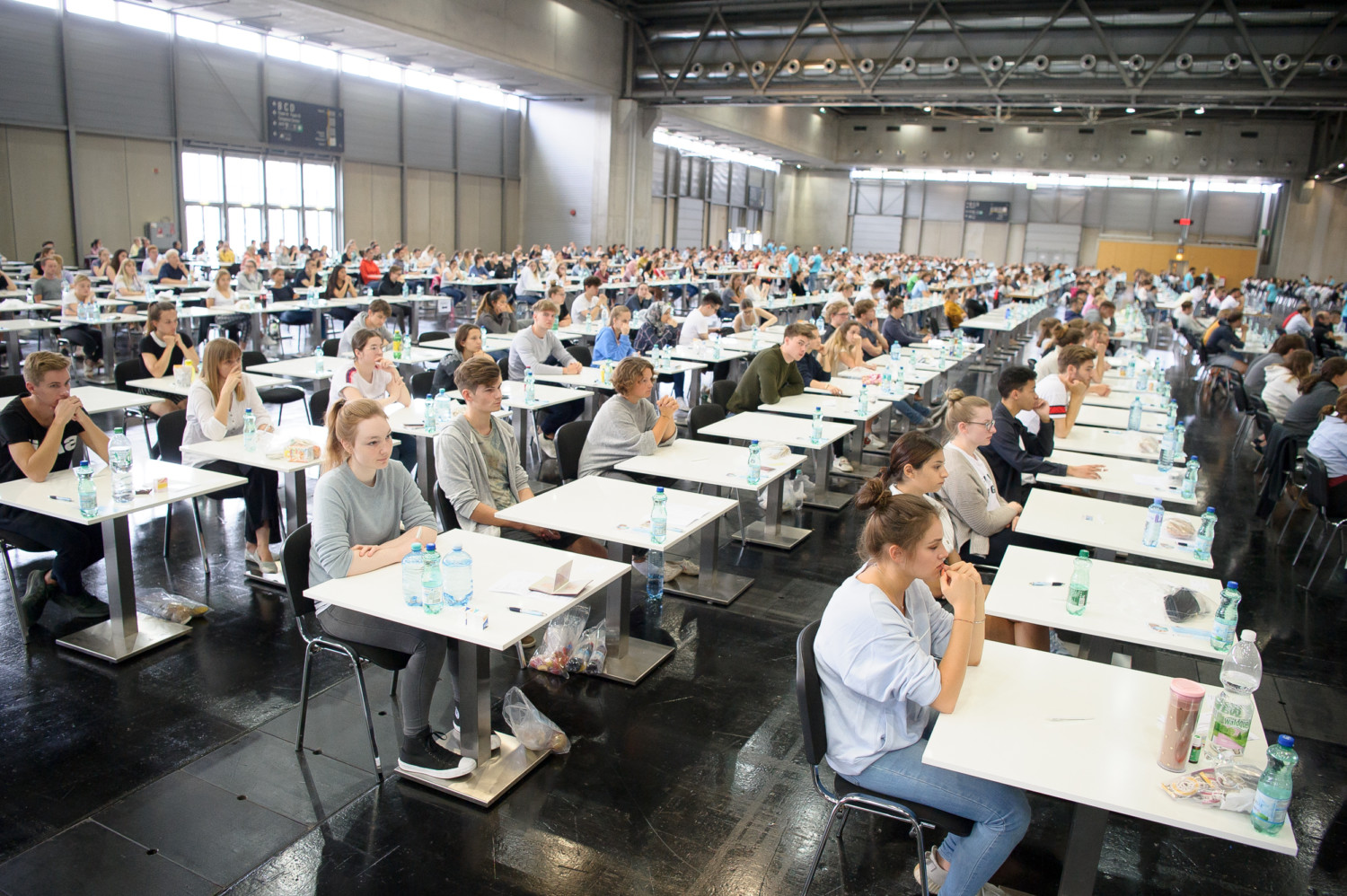
- Recent BBE and WISO exams have been held at VIECON, Vienna Congress and Convention Center (Messe Wien).
- BBE start is winter semester only; WISO can allow winter or summer start after a successful procedure.
Who should choose BBE or WISO?
Lean toward BBE if…
You want to study fully in English, prefer a smaller international cohort, and are ready for a highly selective written exam with an English section.
Lean toward WISO if…
You are comfortable studying in German, value a larger programme with more later specialisation options, and may want a summer-semester start after a successful selection procedure.
Consider both if…
Your language skills support either path and you want a second chance at a WU bachelor seat. The Hybrid course keeps both papers in one plan: shared math and economics, plus the English and German sections each exam still requires.
Preparation differences that actually matter
Mathematics and basic economics preparation can transfer between the two exams. What does not transfer is the language section: and for BBE, the multi-statement scoring behaviour is another skill you must train deliberately.
| Prep area | Transfers to both? | What to do differently |
|---|---|---|
| Mathematics fundamentals | Mostly yes | For BBE, also train multi-statement stems and timed blocks so one question does not eat the clock. |
| Economics / business basics | Partly | BBE prep typically centres on the required Fuhrmann chapters with precise definition reading; do not assume open-ended “business trivia” study is enough. |
| Language section | No | BBE needs steady English reading + grammar/vocab practice. WISO needs German comprehension. Swap languages and you lose the section. |
| Scoring tactics | BBE-specific | Learn when to leave a statement unmarked. Over-ticking false statements can wipe out correct work on the same stem. |
| Mocks and diagnostics | Format-specific | Sit practice that matches the exam you will take. A German WISO drill will not diagnose your BBE English section. |
For BBE applicants, the highest-leverage sequence is usually: understand format and scoring, run a diagnostic, close topic gaps, then add timed mocks. A practical starting point is the free demo course, followed by a diagnostic-style mock exam.
Common myths about BBE vs WISO
- “WISO is just the easy German version of BBE.”
- Not accurate. WISO is a different programme with its own scale, language, and curriculum options. It is less scarce on seats, but it is still a competitive WU bachelor intake.
- “If I prepare for one exam, I am ready for both.”
- Shared math and economics skills help, but the language section and ranking pools are separate. Treat each registration as its own race.
- “BBE is only for international students.”
- BBE is English-taught and attracts an international cohort, but eligibility depends on WU’s official requirements: not on nationality alone.