Official Answer Sheet Simulator
The step almost nobody practices
Students spend months on math, English and economics. Then the exam ends with forty answers that still have to be carried over onto an optical sheet while the clock is running down. That last stretch is where a lot of strong candidates quietly lose points they had already earned.
"I knew every answer. I just ran out of time writing them down.": a repeat applicant, after his first attempt
Almost nobody trains it. People drill questions, not the transfer. So on exam day even students who were at the top of their class suddenly find themselves checking row numbers twice, second guessing an alignment, or racing the last three minutes with eight answers left. The sheet does not care that you knew everything on your scratch paper.
That is a big part of why straight A students with expensive tutors still walk out without a seat. The material was never the problem. Nobody prepared them for the last ten minutes.
The panel on the left is the tool itself, running exactly as it does inside a mock exam. Name fields, signature, exam ID, and a forty row grid that behaves like the printed original. Nothing here is a picture of the sheet; it is the sheet you will actually work with.
- Built into every mock exam, on the same running clock.
- Every mark stays editable until you press submit.
- Fill it row by row, block by block, or all at the end.
Do it a dozen times in practice and the transfer stops being an event. It becomes the quiet, automatic ending of an exam you have already finished in your head.
How it lives inside our mock exams
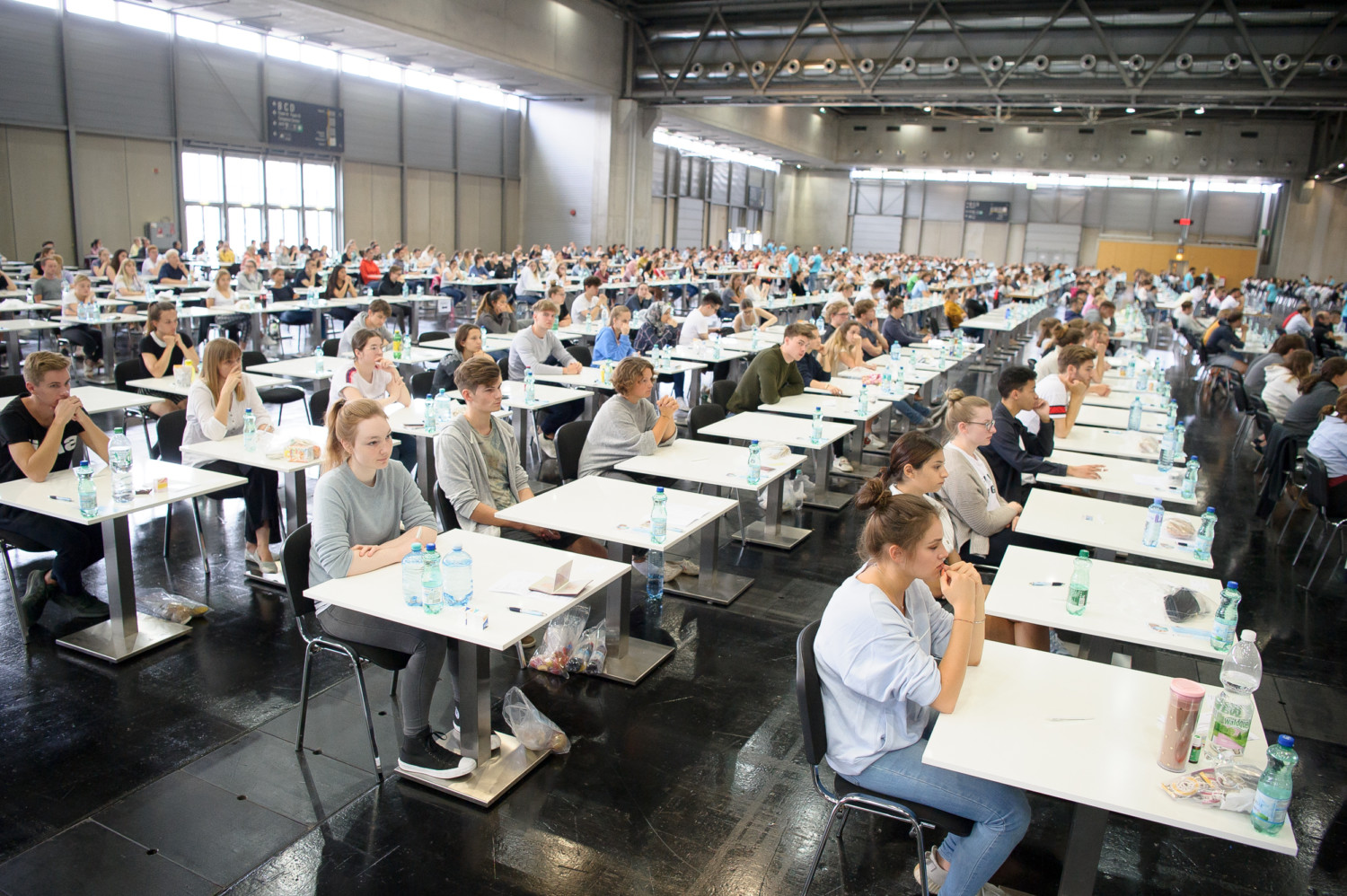
The simulator is not a separate exercise you open once and forget. It sits inside every mock exam on the platform. You start the exam, the timer starts with it, and the answer sheet is right there next to your questions the whole time. Everything you do on it counts toward the same clock, exactly like in the hall at Messe Wien.
You fill in your last name, first name, signature and exam ID first, just like the real document, and then you work the grid. Marks can be placed the moment you finish a question, or in blocks of ten, or all at once at the end. You can change any mark at any time, jump back to question 7 after you already filled question 31, and clean up a row you rushed. Nothing is locked until you submit.
- The same header fields: last name, first name, signature, exam ID.
- The same grid and the same row logic as the printed optical sheet.
- Every mark editable until you submit, so a rushed row can be cleaned up.
- One shared timer for solving and transferring, never two separate clocks.
That freedom is deliberate. There is no single correct way to transfer answers, and we are not going to teach you one. What actually matters is that you find the method that fits how you think, and then repeat it until it costs you no attention at all. Some students transfer after every block because it calms them down. Others hold everything on the question paper and give themselves a firm eight minute window at the end. Both work. Both fail if you try them for the first time on exam day.
What we actually recommend
Fill in the answer sheet right after you finish a subject. Not earlier, not at the very end.
This is the fastest and most reliable rhythm we have seen in practice. When you close a subject and immediately move its answers over, your head stays inside one subject at a time instead of jumping back and forth between economics rows and math rows. The block is fresh, the numbering is still in your short term memory, and you are checking one clean range of rows instead of hunting through the whole grid.
It also leaves you room to change your mind. You still have the rest of the exam ahead of you, so if something clicks later, you can come back and fix a mark calmly instead of doing it in the final minute with a queue already forming at the front of the hall.
The real goal: budgeting the time
The main job of this feature is to train you to set aside time for the transfer and to protect it. Students lose seats because they treat those minutes as free. They are not free. They cost you somewhere between five and ten minutes depending on your method, and if that cost is not already in your plan, it gets taken out of your last questions.
After a few timed runs you will know your own number. You will feel when it is time to stop solving and start transferring, without looking at the clock and without the small spike of panic that ruins the rows. That instinct is the whole point, and it is impossible to build by reading about it.
"The sheet should be the boring part of your exam. If it is the stressful part, you simply have not done it enough times yet."
Do it enough times here and exam day stops being your first attempt.
Practice the transfer before it costs you a seat.
Included with the Full BBE Course · Available inside every mock exam
What the simulator trains
Official WU layout
The same fields, the same grid, the same transfer workflow you will meet on the real optical sheet.
Timed inside mock exams
The clock keeps running while you transfer, so the minutes you spend here are minutes you have budgeted for real.
Your own rhythm
Fill it in block by block, question by question, or all at the end. The simulator lets you move answers around whenever you want.